
OzoneBio grows its team and production capacity at the Life Sciences Innovation Hub
General, 28 Sep 2026
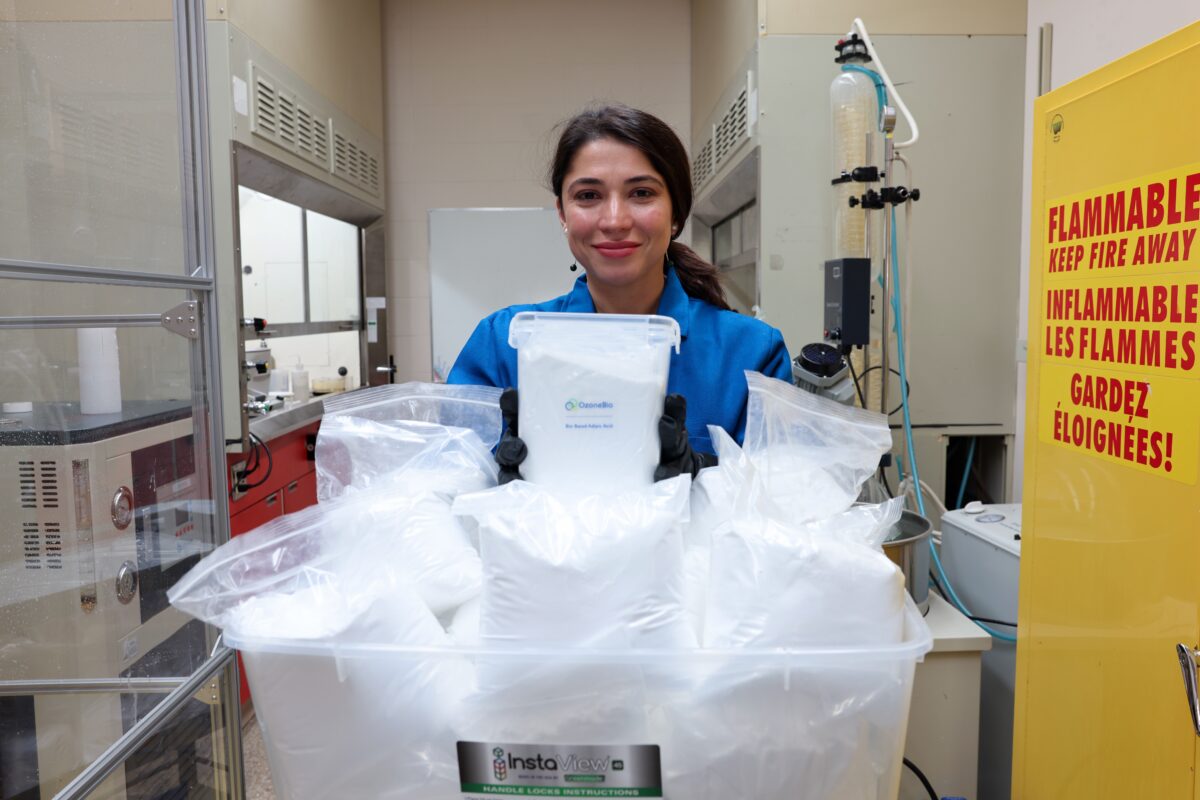
A year can make a remarkable difference in the life of a growing company. For OzoneBio, it has meant expanding from five employees to 14, doubling its facility at the Life Sciences Innovation Hub and moving closer to supplying bio-based materials for everyday products.
The Calgary company turns wood waste and other underused materials into chemicals that can replace ingredients traditionally made from petroleum. Its current focus is bio-based Nylon 66, a durable material used in products such as outdoor clothing and sportswear.
When Innovate Calgary last spoke with OzoneBio, the company had reached a major technical milestone: its bio-adipic acid, a key ingredient in Nylon 66, had been made into polymer and spun into yarn. Since then, OzoneBio has expanded its production in Calgary and continued testing how the material performs as yarn and fabric.
“We’re at the stage where we can supply the polymer that has a full application in the high-performance textile sector,” said Khorcheska Batyrova, OzoneBio’s CEO and co-founder.
The company is now supplying samples of its bio-based yarn to major fashion brands and working on a prototype for a lightweight mountaineering jacket. OzoneBio is also building its capacity to polymerize the material into Nylon 6,6 pellets and supply bio-based Nylon 6,6 to manufacturers across North America. This gives the company greater control over the material development process, from biomass-derived feedstock through to the polymer used by textile and other manufacturing partners.
For Khorcheska, those tangible products matter because they show potential customers that a material made from wood waste can work in familiar, demanding applications.
OzoneBio’s growth has taken place at the Life Sciences Innovation Hub. The company began in shared lab space, moved into a private lab and has since doubled that space as its team and production needs grew.
“We were able to scale from lab to pilot,” Khorcheska said. “We got successfully to the pilot scale here with the help of the Life Sciences Innovation Hub.”
The next step is a demonstration facility capable of producing approximately 100 tonnes of bio-based Nylon 66 per year. OzoneBio is looking for a location close to a source of wood fibre and plans to raise funding for that expansion. The facility would support larger-scale production and qualification of bio-based Nylon 6,6 for textile and other manufacturing applications. Khorcheska sees an opportunity to make use of forestry byproducts and potentially repurpose existing industrial infrastructure.
For now, the work in Calgary is helping OzoneBio show brands what is possible: a high-performance textile material made from a feedstock that does not compete with food crops. Its expanding team, facility and production capacity are bringing that possibility closer to market.