
CURA is helping to build a lower-carbon future for cement producers
General, 10 Aug 2026
Cement is essential to the buildings and infrastructure that we’re familiar with every day, but producing it comes with a significant environmental cost.
Calgary-based climate technology company CURA is developing a new way to address that challenge by removing carbon dioxide from limestone before it is used to produce cement.
The company’s proprietary technology could help cement producers reduce emissions from their operations by up to 85 per cent, while avoiding a significant increase in production costs.
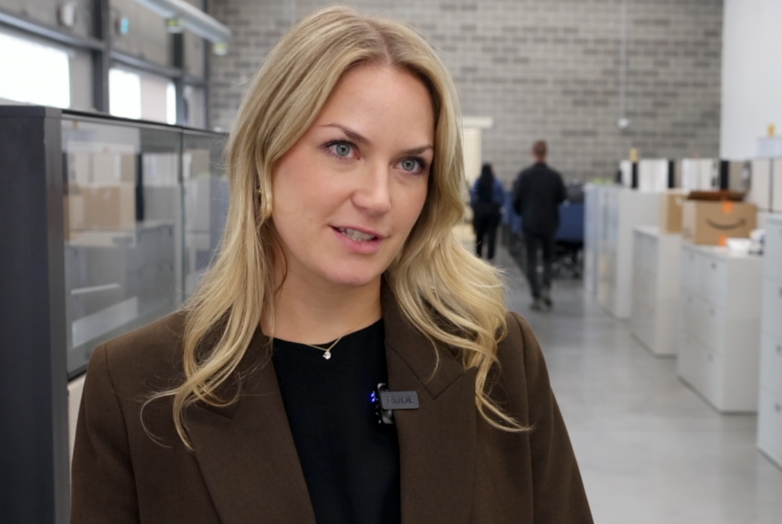
For CURA Co-Founder and Chief Operating Officer Sabrina Scott, bringing that technology to market combines her background in chemistry with her interests in construction, entrepreneurship and developing practical solutions to climate challenges.
“As a scientist, I think that we have a duty to really focus our efforts on trying to make the world better,” Scott said. “Chemistry has arguably caused a lot of problems in the world, but it can also generate a lot of solutions.”
Scott first worked on what would become CURA’s core technology while completing her postdoctoral research at the University of British Columbia.
As part of the scientific team developing the technology, she began speaking with major cement producers to better understand the industry and determine whether the research addressed a genuine market need.
Those early conversations gave her confidence that the technology had significant commercial potential.
CURA’s approach is designed to reduce emissions without dramatically increasing the energy or cost required to produce cement. That economic consideration is critical when introducing a new technology into a commodity industry.
“When you’re decarbonizing a commodity, you really have to compete with commodity pricing,” Scott said.
CURA aims to help producers manufacture lower-carbon cement without placing a substantial premium on the construction materials their customers depend on.
For Scott, moving from researcher to company founder was an unconventional but increasingly viable career path.
“If you’ve focused on research that has potential applications in industry or is able to fill some sort of market gap, then you as the expert are really the leading authority to bring that to market,” she said.
Scott grew up in Calgary and completed her bachelor’s degree at the University of Calgary. When CURA’s founders began considering where to establish the company’s headquarters, Calgary’s growing innovation ecosystem made the city a natural fit.
“We ultimately decided on setting up our headquarters in Calgary because of the significant ecosystem structure built here,” Scott said.
The company had accessed resources through several institutions during its early development. Establishing CURA in Calgary allowed Scott to reconnect with UCalgary while accessing commercialization support through Innovate Calgary and the broader local innovation community.
Around the same time, Scott learned about the Innovation Catalyst Grant.
Delivered by Innovate Calgary, the fellowship supports recent science, technology, engineering and mathematics graduates as they work to commercialize innovative, science-based technologies.
CURA was selected to participate in the program’s fourth cohort.
Scott says the opportunity arrived at an important point in the company’s development. Much of her existing professional network had been built in Vancouver, and CURA was still establishing its presence in Calgary.
Through the Innovation Catalyst Grant, the company gained access to commercialization training, fellow founders, funding organizations and specialists who could help with areas such as intellectual property strategy, grant writing and scientific research and experimental development tax credits.
“It really just opened up that network immediately and helped us get our foot in the door right away here,” Scott said.
That network has become an important resource as CURA navigates the challenges of building an early-stage science-based company.
“Building your network is one of the most important things that you can do as a founder,” she added.
CURA is now following a staged approach to move its technology from laboratory research toward commercial deployment.
The company has commissioned an operational mini pilot at Exergy, where the team is generating data to guide the next phase of development.
A larger field pilot is expected to come online in early 2027. Designed to operate at approximately 100 tonnes per year, the pilot will help demonstrate that CURA’s technology can work at a meaningful scale and produce the data required to develop its first commercial unit.
That commercial system is expected to operate at approximately 30,000 tonnes per year.
CURA is also working with Grand Forks Concrete in southern Alberta. The partnership is helping the company validate its technology and economics alongside a potential industry user.
“By being able to scale the technology in partnership with a key stakeholder that’s interested in accessing our technology, it really allows us to head to market faster,” Scott said.
Moving from scientific discovery to commercial deployment is a complex journey, particularly for technologies that must operate at an industrial scale.
With its headquarters established in Calgary and support from the Innovation Catalyst Grant, CURA is building the partnerships, network and commercialization pathway needed to bring its technology to the cement industry, helping to create a lower-carbon future.
Keep up with innovation at UCalgary
Discover the latest stories, programs, opportunities and events from Innovate Calgary.